The effects of Japanese Tsunami and Nuclear Problem

3:02 PM Reporter: Baris Sanli 0 Responses

Demand Side:
1.
“At least five Japanese-owned refineris with total capacity 1.5 million b/d (1/3rd of Japanese capacity is shutdown)” (Ref:1)
2. “Some 9.7 Gw of nuclear power generation—30% of Japan’s total nuclear power capacity and 7% of Japan’s total power generation capacity—were shut down” (Ref:1)
3. 9.7 GW= 9.7*8.000=77.6 TWh of nuclear energy should be substituted by natural gas and coal. Assuming 50% of this lost capacity to be substituted by LNG = 38.8 TWh. That much of electricity can be obtained by at least 7.09 bcm of LNG (Sources claim as much as 10 bcm)
4. Estimated additional demand of coal can be 5m-30m tonnes (Ref:2)

International Markets:
1.
Natural gas prices : up 7.7% (Ref:2)
2. Oil : down 1.94% (Ref:2)
3. Coal: By April 1, previous record of $125/ton (Australia) may be topped. (Ref:2)

European Nuclear Firms:
-
European energy firms like EON(-8.52%) , RWE (-%7.95), EDF (-11%) (Ref:3)
- Also check mining firms from here : Ref:3
- "German Chancellor Angela Merkel said on Tuesday that all seven of the country’s nuclear power plants which began operation before 1980 would be provisionally shut down." (Ref:5)


Finance:
- There is probably more uninsured damage in the destruction of North East Japan than in any other event in history – and uninsured damage falls sharply on banks. (Ref:4)

Ref:1
http://www.cges.co.uk/media/articles/2011/03/15/japan-quake-scrambles-market
Ref:2 http://blogs.ft.com/energy-source/2011/03/14/energy-market-disruption-in-figures/
Ref:3 http://ftalphaville.ft.com/blog/2011/03/15/514546/euro-nuclear-paralysed-and-paralysing/?utm_source=twitterfeed&utm_medium=twitter
Ref:4 http://ftalphaville.ft.com/blog/2011/03/14/513446/super-catastrophe-and-super-banking-risk
Ref:5 http://blogs.ft.com/energy-source/2011/03/15/germany-shuts-down-all-pre-1980-nuclear-plants/?utm_source=twitterfeed&utm_medium=twitter


Read more...

If a human slave is 80 Watt/hour, energy algebra of modern life is…

3:52 PM Reporter: Baris Sanli 1 Response

Yesterday, I was reading that new book titled “Energy for a Sustainable World: From the Oil Age to a Sun-Powered Future” by Nicola Armaroli and Vincenzo Balzani.

The book looks pretty interesting, and the figure from “De Rebus Bellicis”( http://en.wikipedia.org/wiki/De_rebus_bellicis) is quite interesting. However what was the funny and witty(or weird) thing was the human-energy algebra done by the writers.

In Chapter 3, “Energy in History”, the writers compare the Roman society and modern society.They first assume human power like a traditional source of power in Watts(http://en.wikipedia.org/wiki/Watt) , like Watts in CFL or light bulbs. They claim:

  • A (slave) people can work constantly at a rate of 50-80 W (in short bursts 800W momentarily p.29)
  • Working animal ranges from 300W (oxen) to 700-800W (for good horse, p.27)

So what is the cost of modern life in terms of slaves? Answers are:

  • Washing machine: 800W : 10 human slaves
  • Electrical heating: 2.5 kW: 30 human slaves
  • A small European Cutter: 3.5kW (work done with this cutter for one hour equals to a work done by 4 human slaves in whole day-10-12 hours I guess)
  • A medium sized car: 80 kW consumes the energy equivalent to 1000 human slaves
  • A Boeing 747-400 needs 80 MW to take off = 1 000 000 human slaves

And it claims, an average Italian citizen has as many as 55 energy slaves 24/7.

They also carried out a cost of energy by slave and gasoline. Since a slave can produce an amount of 800Wh in one day (in 10 hours constantly) and one liter of gasoline’s energy content is 12.9 kWh. So 1 liter of gasoline’s energy = 16 human slaves in all day. That means €0.03 for one human slave/day.

See how cheap the services granted by fossil fuels and modern technology.

Reference:

Energy for a Sustainable World, Nicola Armaroli and Vincenzo Balzani, Wiley -VCH. , 2011

http://www.amazon.com/gp/product/3527325409/ref=pd_lpo_k2_dp_sr_1?pf_rd_p=1278548962&pf_rd_s=lpo-top-stripe-1&pf_rd_t=201&pf_rd_i=0470209836&pf_rd_m=ATVPDKIKX0DER&pf_rd_r=01TSXV71YMTZMH8Q2R6D


Read more...

Energy Vision 2011 - A New Era for Gas

10:20 AM Reporter: Baris Sanli 0 Responses
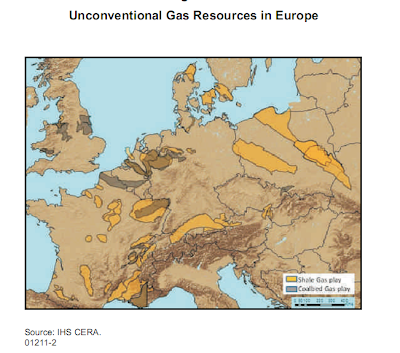
World Economic Forum's report is an interesting piece to read. There are numerous high profile comments in it. However as the #ceraweek suggests, some personal comments contradict with what is inside this report. One of the interesting maps in the report is this:
Also, 2010 gas figures can be found:
2010 Natural Gas Production by Region
Europe, 286 bcm
Middle East, 407 bcm
Africa, 213 bcm
Latin America, 148 bcm
North America, 749 bcm
Former Soviet Union, 751 bcm
Asia, 414 bcm,

Read more...

CERA Week notes from Platts

9:41 PM Reporter: Baris Sanli 0 Responses
Quick Summary
  • "An energy crisis is coming -- likely to be triggered by oil," Hess said.
  • we have already produced 1 trillion barrels and have approximately 2 trillion barrels remaining
  • The energy density of today's best battery is 200 watt-hours per kilogram versus the energy density of gasoline which is 13,000 watt-hours per kilogram
  • steam to oil ratio at many of the oil sands' in situ projects has dropped to 2-2.5, meaning for every unit of oil produced
http://www.platts.com/weblog/oilblog/2011/03/07/cera_week_a_run.html

Read more...

Feb 2011 Update - Turkish Installed Capacity 50004 MW - Peak Demand 32675 MW

1:47 PM Reporter: Baris Sanli 0 Responses
Turkish installed electricity generation capacity reached 50004 MW according to TEİAŞ. It is also noted that peak demand at the system concurred on the Feb 1st, 2011 at 1740 hours with 32675MW. Top daily demand has exceeded 670 GWh on the same day. As of Feb 23rd, 2011, the breakdown of installed capacity is as follows (check official sources to make sure)
  • Natural Gas: 18361.75 MW (including mixed fuels)
  • Hydro: 16159.1 MW
  • Lignite: 8139.6 MW
  • Exported Coal: 3281 MW
  • Fuel Oil : 1448.78 MW
  • Wind : 1357.95 MW
  • Other: 826.7 MW
  • Hard Coal(domestic production): 335 MW
  • Geothermal: 94.2 MW

Source: TEİAŞ


Read more...

Extraordinary IEF Ministerial Meeting - Expansion of Jodidb.org is expected

1:20 PM Reporter: Baris Sanli 0 Responses
According to concluding statement of "Extraordinary IEF Ministerial Meeting" (Feb 22,2010), my favourite oil database will include natural gas data as well as capacity additions.(IEF : International Energy Forum)

Jodidb.org is a website publishing oil statistics for both exporting and importing countries'.

Starting from the final word, the dialogue forum aims to:

  • Mitigate energy market volatility and future uncertainty
  • Better data transparency-Internationally coordinated regulation
  • a better common understanding of energy market trends and energy outlooks

Concluding statement has a summary of three different discussions:

1. Physical and financial markets’ linkages and energy markets regulation : no censensus

  • 1st group "underlined the role of excessive financial speculation in the surge in prices and volatility"
  • 2nd group "especially those involved in price reporting, felt that spot markets set their own prices, independently of any influence from financial markets"
  • 3rd group "it is difficult to construct theoretically and test empirically ... whether market drives the physical or the other way around. "

2. Shared analysis of energy market trends and outlook

Aim: improve clarity and understanding of the various outlooks. (there are comparisons between IEA and OPEC's forecasts)
  • both the IEA and OPEC’s projections were similar in terms of supply/demand growth figures for 2011
  • uncertainities : future demand, economic growth and technological change.

3.Jodi Database (most importantly)The extension of JODI to cover monthly natural gas data is now well under way, The extension of JODI to annual data on upstream and downstream capacities and expansion plans will start with oil and is currently under way, with first results expected at the earliest in 2012.

Ref:
http://www.ief.org/whatsnew/Documents/EMM%20Joint%20Concluding%20Statement.pdf
http://en.wikipedia.org/wiki/International_Energy_Forum
http://www.ief.org/whatsnew/Pages/ExtraordinaryIEFMinisterialMeeting,22February2011,Riyadh.aspx
http://www.jodidb.org/TableViewer/tableView.aspx

Read more...

Direct Facts - Econbrowser's Brent-WTI Spread

12:39 PM Reporter: Baris Sanli 0 Responses
There is plenty of discussion about the spread between WTI-Brent. There are numerous articles on this. What I want to show you is the spread between WTI and others. Econbrowser has a nice graph of this. Textbook says "if there is price differences between two or more markets, arbitrage opportunities exits". (Check this)

Now there are reasons for this price differentials. Paper oil ( "buy WTI futures and sell Brent futures" ) is one of them, but speculators are not as active as in 2007. But website suggests a few solutions:
  • Running the Seaway pipeline, which is currently delivering oil from the (Freeport, Texas) Gulf of Mexico to Oklahoma, in reverse. ConocoPhilips is not interested in this idea because of a fear for political criticsm and most importantly on economical grounds ("As an integrated refiner and producer, it can take its profits either as refinery margin or producer-seller.") . “A reversal would send up to 350,000 barrels a day of crude from Cushing directly to Houston, significantly releasing pressure on the Cushing complex,” said JBC Energy GmbH, a Vienna-based researcher. "
  • "It ... costs $6 to ship a barrel from Cushing to the Gulf of Mexico by rail or $10 by truck"
Ref: Econbrowser
http://www.econbrowser.com/archives/2011/02/brentwti_spread.html

Read more...

Quick Summary of IEA's Libya Brief

12:26 PM Reporter: Baris Sanli 0 Responses
IEA has published a brief on its website you can download it from here. The brief include a nice map of Libya's oil ports. Here is a quick summary:
  • Libya's oil production (crude+NGL): 1.69 million b/d (Jan 2011)
  • 1.49 mb/d is exported. Domestic consumption 270 kb/d
  • 1.2 mb/d is exported to IEA countries.
  • 150 kb/d is exported to China
  • East Libya exports 684-958 kb/d (is there a mistake on page 2?)
  • West Libya exports 199-270 kb/d
  • Biggest importer for Libyan Jet Kerosene and Residual Fuel Oil is Italy, where Turkey, Spain, Germany, Greece and France has minute shares. (page 3, bottom)

  • Libya exports natural gas to Italy(via Greenstream underwater pipeline) and LNG to Spain. Italy imports 26 mcm/d. Spain imports 1.5 mcm/d


Read more...

Houston, We have a problem! - Texas's Rolling Blackouts of February 2011

3:20 PM Reporter: Baris Sanli 0 Responses
On Feb. 2nd 2011 :
A trio of events - loss of supply, higher demand and maintenance outages - led to Wednesday's emergency rolling blackouts across Texas and spiking power prices as the grid operator for most of the state struggled to accommodate a brutal winter storm.
Here is my collection of events from various links...
In 2008, Texas has been on the edge of a rolling blackout.
"On February 26, 2008, the Electric Reliability Council of Texas (ERCOT) called for an Emergency Electric Curtailment Plan (EECP) at 18:41 due to a worsening imbalance between generation and load which led to a decline in system frequency"
Read here (http://www1.eere.energy.gov/windandhydro/pdfs/43373.pdf)

In 2011, (Feb 2 & Feb 3) Texas has suffered from blackouts. The Oil Drum has a nice summary of the events : ( http://www.theoildrum.com/node/7449 )
A summary of events is available from this site : (http://www.oncor.com/news/newsrel/detail.aspx?prid=1297)
"Wednesday’s peak demand is currently projected to be more than 54,000 MW between 8-9 p.m. , and more than 58,000 – which would be a new winter record – between 7-8 a.m. on Thursday. The current winter peak demand record is 56,334 MW which occurred Feb. 2, between 7 and 8 p.m.
The grid continues to have about 2,700 MW of generation capacity unavailable because of unplanned or forced outages."

These 2700 MW of generating capacity are probably these two plants:

Texas Lt. Gov. David Dewhurst said the Luminant-owned 1,640 MW Oak Grove plant east of Temple and the 1,137 MW Sandow plant near Rockdale were among the plants knocked offline by the storm. Oak Grove suffered a broken pipe and Sandow was hampered by a frozen pipe. Allan Koenig, communications director for Luminant, said its Oak Grove and Sandow power plants "accounted for just a small percentage of the 50 units and 7,000 megawatts."

So it was cold weather, pipes and low pressure on natural gas lines:

Wednesday. Lt. Gov. David Dewhurst said this is something that “should not happen.” Dewhurst said he was told that water pipes at two plants, Oak Grove and Sand Hill, forced them to cut electricity production. Natural gas power plants that should have provided back up had difficulty starting due to low pressure in the supply lines, also caused by the cold weather.
I am not quite sure about this:
But, Fraser said, some power cuts affected some stations for compressing natural gas — so without power they couldn't pump gas, causing some gas power plants to go offline
The complaints followed :
"The blackouts left many people angry and frustrated. Cuellar said Oncor’s call center has been overwhelmed with about 60,000 calls an hour."
Also a family blamed these outages for causing their son's death

So the market worked and prices soared to 3000$/ MWh

As a result of the outages and demand, real-time power prices peaked around $3,000/MWh during some intervals Wednesday afternoon.

Average prices at this time of year normally would be less than $100/MWh, Doggett said.
Emergency measures started:

In addition to the default Energy Emergency Alert 0, or normal operations, there are four EEA levels: EEA Level 1, EEA Level 2A, EEA Level 2B and EEA Level 3, which is the most extreme.

ERCOT first contacted market participants at 4:45 am CST on Wednesday to warn the companies of inclement weather. ERCOT declared EEA Level 2A at 5:17 am

Less than a half-hour later, ERCOT declared EEA Level 3 at 5:43 am, at which point the grid operator asked distributors to shed firm load of 1,000 MW, said ERCOT spokeswoman Dottie Roark.
A timeline and detailed discussion is available from here:


More information about Texas home heating is available here

As a final reading, I offer "Normal Accident Theory" from NASA:

Failure in one part (material, human, or organization) may
coincide with the failure of an entirely different part. This
unforeseeable combination can cause cascading failures of
other parts.
In complex systems these possible combinations are practically
limitless.


Read more...